Creatine is the most researched supplement in sports science. More studies, more clinical trials, more replicated data than almost anything else in the fitness world. And for decades, it was written off as a supplement for male bodybuilders who wanted to get huge. The result is that most women have never touched it, and most are not even sure what it is.
The research has completely changed that story. What the science now shows is that creatine may be one of the most valuable supplements a woman can take, and the benefits have almost nothing to do with getting bulky.
What Creatine Actually Does
Your muscles store a molecule called phosphocreatine. When you do anything explosive or high intensity, your body breaks it down instantly to regenerate ATP, which is the fuel your cells run on. You deplete that store fast, usually within ten seconds of hard effort. Then your body has to slow down and wait for ATP to be produced through slower pathways.
Creatine supplementation raises the amount of phosphocreatine your muscles can store. That means more fuel available for those intense bursts of effort, faster recovery between sets, and better output over the course of a training session. It is not a stimulant, it is not a hormone, and it does not do anything dramatic. It just makes the energy system that powers your hardest efforts more efficient.
The Muscle Loss Problem Nobody Is Talking About
Here is where women specifically need to pay attention. After age 30, women begin losing muscle mass at a rate of roughly three to five percent per decade. After menopause, that rate accelerates. Muscle loss drives a slower metabolism, increased fat storage, reduced bone density, and a higher risk of falls and fractures later in life. The medical term is sarcopenia, and it is one of the most predictable and preventable health risks women face.
A 2021 review published in the Journal of the International Society of Sports Nutrition found that creatine supplementation significantly enhanced the effects of resistance training in women across all age groups, with the most pronounced benefits in women over 50. It did not just help them build more muscle during training. It helped them preserve what they had.
The Brain Benefits Are Real
This part tends to surprise people. Creatine is not just a muscle supplement. Your brain uses it too. Emerging research shows that creatine supplementation improves working memory, reduces mental fatigue, and may play a role in supporting mood, particularly in populations under stress.
A 2022 study out of the University of Southern California found that women had lower baseline creatine levels in the brain than men, which may explain why women showed greater cognitive improvements from supplementation in several trials. Researchers have also begun investigating creatine as a potential support tool for symptoms of depression and perimenopausal brain fog, with early results that are genuinely interesting. This is not settled science yet, but the direction of the evidence is worth noting.
What About the Bloating Myth
This is the one that keeps most women from ever trying it. You have probably heard that creatine makes you hold water and look puffy. Here is the more complete picture. When you first start taking creatine, your muscles draw water into the cells as they load up. This is intracellular water retention, meaning it is water inside the muscle, not under the skin. It is actually a sign the supplement is working.
Most women report gaining one to three pounds in the first week or two, and almost all of it is water held inside the muscle tissue. It does not typically cause a puffy or bloated appearance in the way that sodium-driven water retention does. After the initial loading phase, things stabilize. Many women find that with consistent training, their body composition looks and feels leaner over time because they are building more muscle and performing better in the gym.
How to Actually Take It
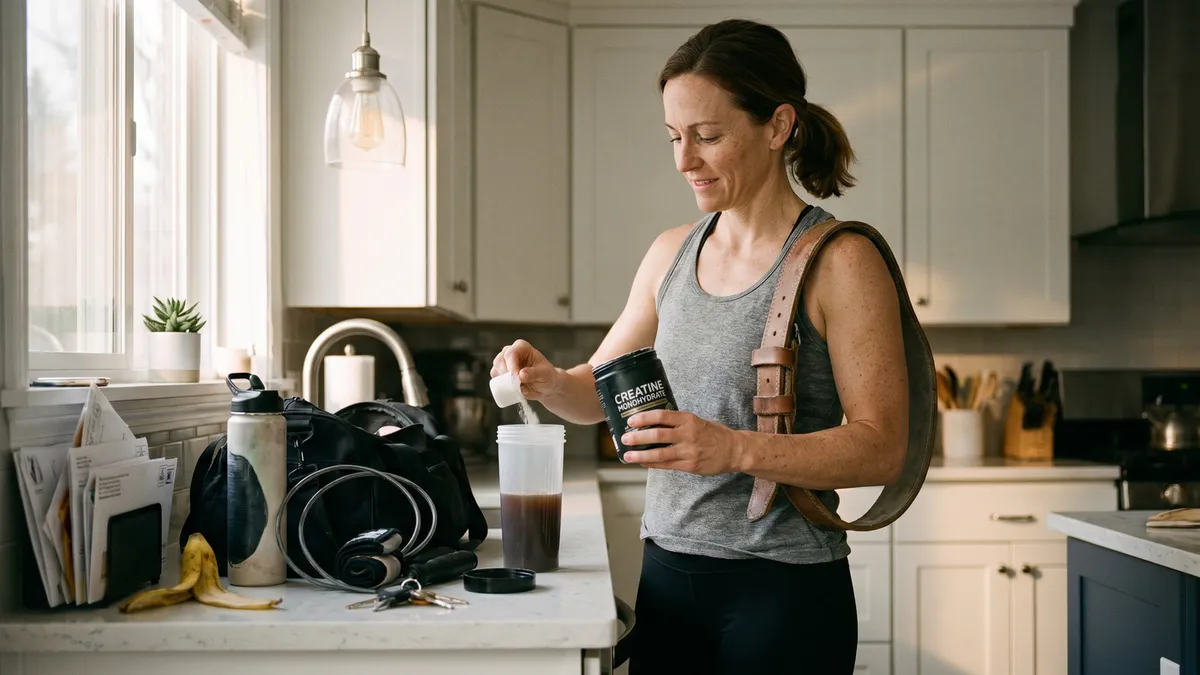
The standard dose is three to five grams of creatine monohydrate per day. That is it. Take it whenever is convenient for you, with or without food. You do not need a loading phase. You do not need to take it at a specific time relative to your workout. Research has compared timing extensively and found no meaningful difference in outcomes when taken consistently.
Creatine monohydrate is the form backed by the research. Avoid the more expensive forms with flashy marketing. They offer no proven advantage. Buy the plain powder from a reputable brand that third-party tests for purity, mix it in water or a protein shake, and take it every day. Results build over several weeks as your muscles saturate.
Who Should Not Take It
If you have kidney disease or are at risk for kidney problems, talk to your doctor before adding creatine. For healthy adults, the evidence for safety is overwhelming, with studies tracking supplementation over multiple years showing no adverse effects on kidney function. But if there is any existing concern in that area, get clearance first. Creatine is also not recommended during pregnancy, simply due to limited research in that population rather than any established risk.
How This Connects to Your Training
Creatine works best when you are actually training hard. Sitting at a desk and taking creatine is not going to do much. But if you are showing up to class, pushing through workouts, and asking your muscles to do real work, creatine helps you get more out of every session. You recover faster between efforts. You can push a little harder in those last few reps. Over months and years, that compounds into real differences in strength, muscle mass, and body composition.
At CrossFit Fig, we train in a way that is designed to get the most out of your body every single day. Every class combines strength work with conditioning. You are building exactly the kind of lean muscle that creatine helps you preserve and develop. If you have been training consistently and looking for an edge that the research actually supports, this is it.
If you are not training yet and want to start, that part comes first. Book a free intro session and come in. We will show you what we do, walk you through the process, and build a plan that fits where you are right now. The supplement conversation can come later. The training is where everything begins.